
Ten ways to turn your entry into prime real estate.
TABLE OF CONTENTS
Contents
Ensure your home makes the right first impression with these tips for organizing a small entryway.
Is your home’s entry a dumping ground for coats, shoes, and kids’ school bags? An entryway can be a nightmare to keep neat and tidy. It can make day-to-day life much harder than it needs to be and doesn’t make for the warmest welcome, either. It’s a cluttered spot that needs organizing. It’s the first thing people see when they walk into your home, it’s an opportunity to create a striking first impression.
Here is some advice on how to create an entry that’s stylish and streamlined.
It’s easy to think a small entryway is not functioning well when it’s just too full. Before you plan a total redesign or start investing in new storage, remove what you don’t need, then reassess.
“Take some time to think about your goals for this space. Do you want to create more storage, create a welcoming entrance, or simply make the area more functional? Having a clear plan in mind will help you to stay focused and make better decisions about what to keep and what to let go of,” says Carly Campbell, founder of a lifestyle blog, Mommy on Purpose.
Here are ten ways to organize a small entryway.
1. Organize by Category. It’s no wonder small entryways end up in disarray when you think of all the daily essentials they are expected to provide. The best way to create order and keep life running smoothly is to group similar items together. Think coats and scarves, shoes and gloves, school bags and homework. Once you’ve done this, you’ll be able to work out suitable space-saving storage ideas and organizational systems for different groupings.
When you’re organizing an entryway, you’ll need to be a little strict on display items that take up surface space. Be careful of vases, photo frames, and trinkets.
“Less is definitely more when decorating a small room where the function is the priority, so when it comes to decor, choose a few favorite pieces that fit the space, rather than trying to cram everything in,” says Campbell.
2. Prioritize Storage Space. Not every single coat and pair of shoes you own needs to live in the entryway at all times. Dedicating prime storage space to items that you’re currently using regularly will keep your entryway tidier in general. Sorting is best done by season. Swap out winter coats, boots, hats, scarves and gloves for sunnier months’ clothing. Stash somewhere you don’t need frequent access to – under the bed, or in the loft, for example.
3. Take Stock of Seasonal Items. Sorting by seasons offers up the opportunity for a good declutter when the time comes to switch it up again. Before you put anything back, go through each item and decide whether you really want or need it. This process is also handy for working out what you need to replace – get your children to try on last year’s winter gear. If it still fits, don’t buy anything new – the more belongings you acquire, the less easy it is to stay organized.
4. Create A Functional Layout. Think about how you use the items in your small entryway and designate areas for them accordingly. When deciding on a layout, it can be helpful to make a paper floor plan of the space available, to help visualize where pieces will fit best. Of all the items to make room for, modern entryway bench ideas are one of the most useful additions to a small hallway.
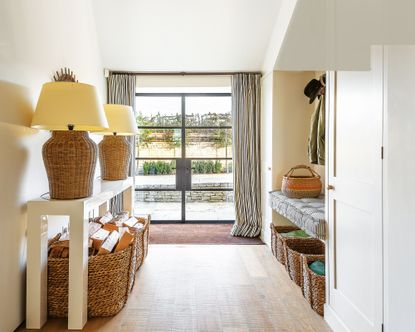
5. Select Smart Storage. Planning practical storage solutions will help make even the smallest of entryways feel calm, organized, and clutter-free. If you’re investing in new pieces, look for multifunctional designs like seats with built-in storage or console tables with drawers for loose change and receipts. Alternatively, look for ways to make existing pieces work harder, such as positioning catch-all boxes and baskets underneath a bench or inside a unit.
6. Keep Things Kid-Friendly. Let’s be honest, children tend to be the worst culprits when it comes to putting things away. The best chance you’ve got is to keep organizational systems as simple and easy-to-use as possible. Think about their school routine and what you need to account for: accessible hooks for coats, open baskets as drop-zones for shoes and bags, wall-mounted cubbies for school books and forms, and so on. If you’ve got a little room to spare in your small entryway, consider giving each child their own dedicated storage space. Labeling them helps too, and gives children a sense of ownership over their own belongings which is a good habit to encourage – if nothing else, it makes getting out of the door in the morning a much smoother process!
7. Free Up Floor Space. Keeping floors clear so people can move around freely is essential, particularly in small hallways where space is tight, so bypass bulky storage solutions in favor of wall-mounted options. Cubbies are great for keeping posts, letters, and kids’ school bags close to hand, while shelving lined with lidded boxes is useful for containing gloves, scarves, hats, and other smaller items. If you’ve got a hallway closet, consider back-of-the-door storage – hanging pockets are particularly handy for organizing shoes.
8. Keep Coat Hooks Under Control. A basic set of hooks is all you need for coats and jackets, but don’t let them build up – trying to get everything on a single set is always going to look messy and overcrowded. Edit your selection seasonally, and limit each family member to one or two at a time, storing the rest elsewhere. Try to leave a couple of hooks free for guest use if you can. “If you have children, consider doubling your hanging capacity with dual-height coat hooks. They’re more likely to hang their own bags and coats up after school if they’re easy to access – although we can’t promise anything,” says Lucy Searle, global editor-in-chief, of Homes & Gardens.