

By Hem-young and Dominic deFazio
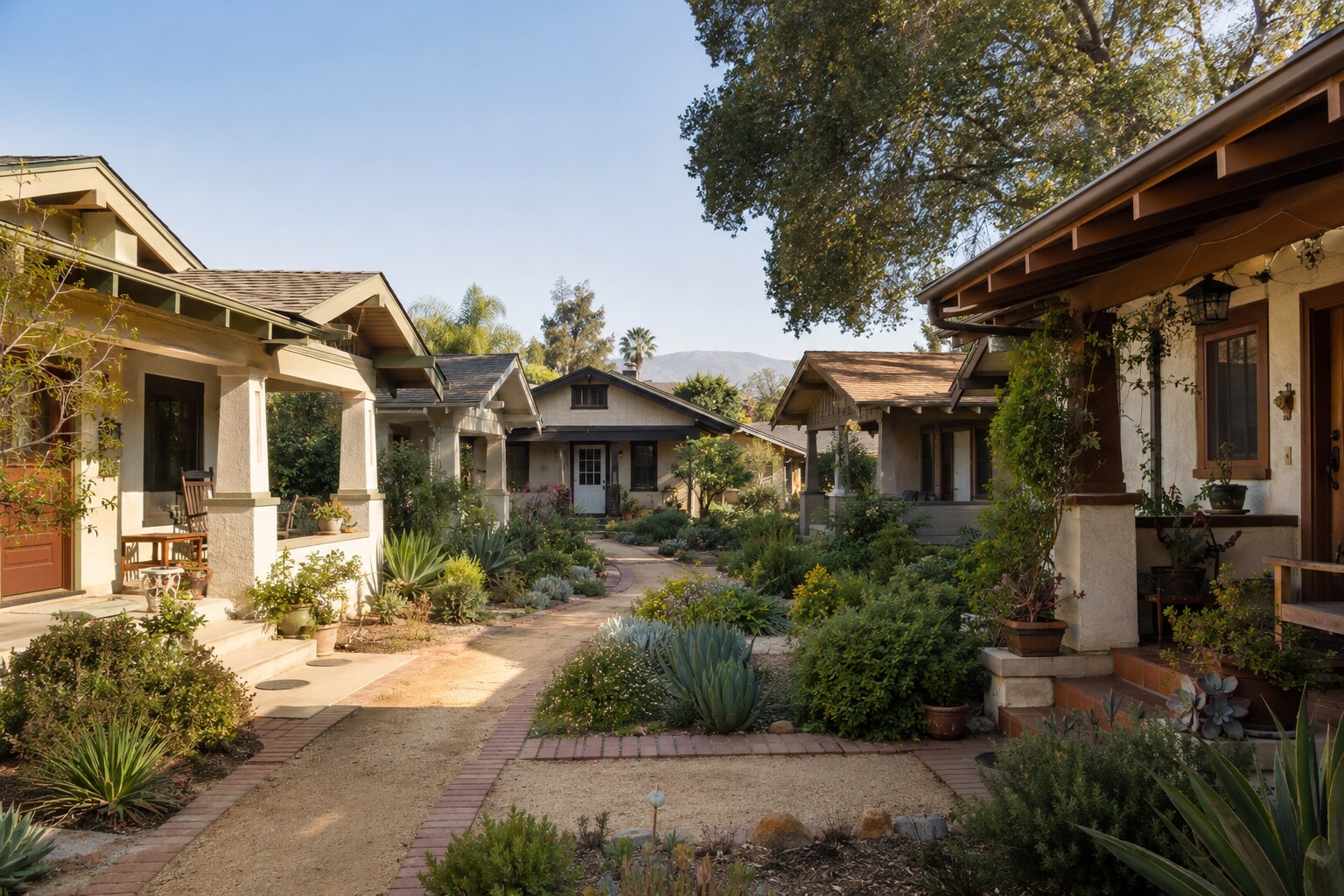
When we represented the owners in the listing and sale of Meridian Court in Pasadena and Mission Meridian Village in South Pasadena, buyers began experiencing the homes before they crossed a threshold. The approach, gardens, porches and shared courts were already suggesting how life there might feel.
That response came from a Southern California tradition with deep roots in our city. Pasadena bungalow courts gave modest homes private front doors while arranging them around a shared outdoor world – a simple idea that created real neighborhoods.
Pasadena Invented a Different Kind of Neighborhood
Pasadena is generally recognized as the birthplace of the bungalow court. The city’s first, St. Francis Court, was designed by Sylvanus Marston and built in 1909. Eleven bungalows, each with its own garden, were arranged as a coherent community rather than as isolated houses or units along a corridor.
From 1909 through 1942, Pasadena bungalow courts evolved from visitor accommodations into permanent residences. Craftsman, Spanish Colonial Revival, Tudor Revival, and even Art Deco versions appeared, but the organizing idea remained consistent: small-scale homes faced a landscaped common space.
The City’s 2010 study identified 112 Pasadena bungalow courts; 43 had historic designation and another 48 were considered eligible. Scarcity adds interest, but design explains their lasting appeal.
The Courtyard Does the Work
A conventional apartment building often moves residents from a parking area through an interior hallway to a unit door. A bungalow court creates a different sequence. Residents pass through a garden, see neighboring porches and arrive at a home that addresses shared space without surrendering its identity.
Cars typically move to the side or rear, letting windows and doors face greenery rather than asphalt. The common landscape becomes the center instead of leftover space around the edges. While marketing modern courtyard homes, we saw buyers respond to that quality of arrival and human scale, not merely to square footage.
Stefanos Polyzoides and the Courtyard Tradition
Our longtime client, architect Stefanos Polyzoides, has done more than admire this tradition. He studied it, documented it, helped preserve it, and demonstrated how it could inform new housing.
In the influential 1982 book Courtyard Housing in Los Angeles: A Typological Analysis, Stefanos, Roger Sherwood and James Tice examined courtyard housing as a serious architectural type. Their research, illustrated with plans and photographs by Julius Shulman, ranged from modest bungalow groupings to more elaborate courts shaped by Spanish, Italian and North African influences.
Stefanos later carried those principles into contemporary work through Moule & Polyzoides. Its projects show that courtyard housing can accommodate modern parking, greater density, mixed uses, and transit without becoming a nostalgic copy of the past.
Architect Liz Moule explains why the original bungalow-court idea remains so relevant today:
“The original Bungalow Courts, created at the turn of the last century, were an ingenious way to provide several valuable things at once: affordability, high quality, sociability, and privacy. They are made up of smaller, detached, high-quality homes at the scale of a single-family house. Both the buildings and the landscape are provided at a very high level. Their courtyard gardens and wonderful porch street frontages promote social interaction in those gardens and on the street. At the same time, the homes have small backyards where family and friends can play and gather on their own. “Most current development fails at all four of these highly desirable qualities that make for both great homes AND great neighborhoods.”
That may be the most important lesson Pasadena bungalow courts offer us today. Their value isn’t merely architectural or nostalgic. They demonstrate that greater density can still feel gracious, personal, neighborly, and remarkably livable.
Two Modern Courts, Seen Through Buyers’ Eyes

Meridian Court, at California Boulevard and Marengo Avenue, translated the tradition into a modern Pasadena residential setting. Its central court was not decoration between buildings; it organized the community experience. Our task as listing agents was to help buyers recognize that value as readily as they recognized a floor plan or finish.
Mission Meridian Village applied the idea at a larger scale. The award-winning South Pasadena community placed 67 condominiums and about 5,000 square feet of retail beside the light-rail station, combining courtyard housing, single-family houses, duplexes, and mixed-use lofts.

Across the two developments, we sold a combined 81 residences. That gave us an unusually close view of buyer response: thoughtfully designed density could offer convenience and connection without erasing individuality. Stefanos and Elizabeth Moule treated history not as scenery, but as accumulated knowledge of how buildings, gardens, and streets fit together.
Why Buyers Still Respond
Pasadena bungalow courts appeal for emotional and practical reasons at once. A porch marks the transition from public to private life; a garden provides outlook and breathing room; individual entrances make multifamily living feel domestic rather than institutional.
Limited supply can distinguish these homes, but charm alone does not establish value. Condition, location, ownership structure, parking, and historic restrictions all matter. When those fundamentals are sound, and the common areas are cared for, buyers recognize a way of living that is difficult to reproduce.
A Pasadena Idea Worth Carrying Forward
We previously explored Pasadena’s hidden courtyards, including historic examples and public spaces. Here the focus is the residential lesson. More than a century after St. Francis Court, Pasadena bungalow courts answer a current question: how can we add homes without losing beauty or neighborly connection?
Stefanos Polyzoides and Liz Moule have spent much of their careers demonstrating that progress does not require copying the past; it requires understanding what worked. Our experience at Meridian Court and Mission Meridian Village brought that principle to life. Designed well, a courtyard is not merely open space. It is the room the neighborhood shares.
Considering a distinctive Greater Pasadena home? If courtyard living, historic architecture, or a thoughtfully designed neighborhood appeals to you, Hem-young would be glad to help you understand the choices and the market.